
Play gives and it takes, it’s serious business. When Fun City closed in 1998, its rides were taken far from Portobello, but no-one took away the arcade, and with Art Walk Projects’ 2025 Arcade commissions, we’re reminded of what play can help us grasp. As game studies scholar Aaron Trammell has it, play takes from the played and gives to the player, across lines sketched out in space, time and power. These relationships are always both ephemeral and historied in their repetition, and in the moment of play artists and their audiences can give fleeting life to dynamic architectures and communities both past and present. This is because, in the words of the late anthropologist Victor Turner, play dwells “betwixt and between” the power structures and geographies of our world, cutting slices out of material reality. Play is a liminal creature drawing imaginary lines on the ground where magic can happen. Hazy horizon, twinkling tide, pitted sand and sodden promenade; while a beach might be a risky place to build on, it’s the perfect place for play to call home.
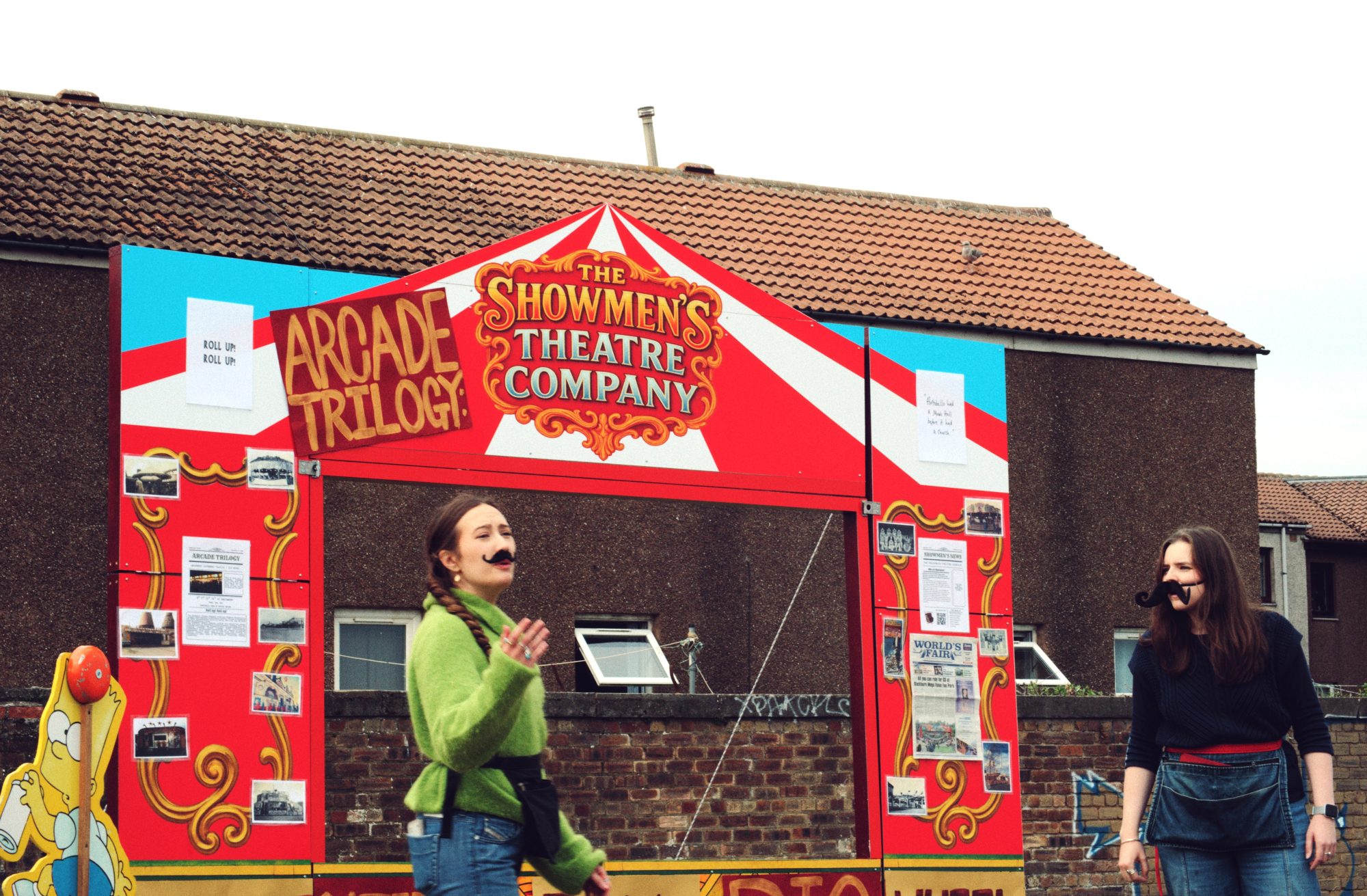
The 2025 Arcade commissions are united by an interest in play betwixt and between land and sea, past and present, give and take. A recurrent refrain of the many artists and performers adding levity to the liminal is a local proverb, “Portobello had a Music Hall before it had a Church”, and capturing and enacting that long history of transient performances is the challenge they take up. During September’s Art Walk Porty festival each work playfully haunted the promenade with ephemeral histories of showmanship and the vanished spaces that once housed play. They let us appreciate how Portobello beach is still home to play, and how play might expose the deep time of fleeting moments through live and looping performances. Moreover, they performed this by criss-crossing social and affective margins, pressing close on the horizon between fantasy and materiality. As the game scholar Ian Bogost argues in Play Anything, magic comes from seeing the everyday anew, giving in to the moment and reclaiming something from moments past, shaping play out of the world. During the festival, passers-by, children, dogs and birds all danced in and out of the audience’s periphery much as they have for decades before and since the ground was laid for Nobles Amusements Arcade with Harry Marvello’s construction of a music hall in 1907.
Dr Merlyn Seller is Lecturer in Design and Screen Cultures at the University of Edinburgh, and Gameworld Research Cluster co-lead at the Edinburgh Futures Institute. Her research concerns nonhuman, eco- and queer/trans game studies, with an interest in materialities, horror, and (post-)phenomenology in play. Recent publications include: ‘_Genesis Noir_ and Cosmological Time: How I Learned to Stop Worrying and Love the Big Bang’ (in _Unbound Queer Time_, 2024) and multiple Digital Game Research Association conference papers.